Best Served Cold
Best Served Cold is a Visual Novel developed by Rogueside using the Unity Engine.
Set in a fictional, alternate universe version of Europe, the player fills the role of a speakeasy bartender who must help a detective solve crimes.
In this project, I took on the role of Narrative, Gameplay and Technical Designer.
Premise
A dialogue with Clara Salo, a humble maid in a hotel who enjoys practicing martial arts.
Best Served Cold aimed to combine the elements of being a bartender and chatting with customers alongside a murder mystery detective experience.
By creating gameplay for each topic and interlinking them, we packaged them into a linear story where major choices still presented some sort of change, more particularly towards the end of the story.
The Bartender Experience
Bartending mainly involved the dialogue with customers and having the ability to influence them.
To do so, I designed the drinks with certain parameters that could influence a character’s intoxication, affection, mood, and willingness to discuss more topics.
All these elements were used to essentially hide aspects of the Detective experience so players had to use drinks to unlock clues.
Whenever a player is “blocked”, an icon shows how they need to influence the character in order to see the dialogue in it’s fullest.
In terms of mixing a drink, we started with an in-depth version where mini-game interactions were needed to produce a drink. After feedback, the team repeatedly requested to simplify it into something that was:
Short enough so you can stay focused on the dialogue.
Was easy to perform and hard to fail, even for those with physical disabilities.
Could still be failed deliberately in order for certain mechanics to stay functional.
I used a very simple line-connection minigame, then added different patterns to keep things somewhat varied and VFX to create some satisfaction as a quick break of otherwise constant dialogue.
After launch, players reported they wished for a more in-depth system that leaned closer to the original concept.
The final version of the Drink Mixing minigame, where the player is making a “Femme Fatale” cocktail by having to progress through the pattern with the gold/green arrow before the red arrow “catches” them.
The Detective Experience
The detective experience originally started more complex than the final result.
By speaking with customers and influencing them with drinks, player could collect vital clues to solve the case.
In the original version, players had to manually assign the clues to certain suspects in order to build the case. Internal feedback suggested this was too much thinking work for what was being marketed as a Visual Novel.
As such, I reworked the system so the game would keep track which clues were valid as evidence. Each suspect now had 2 clues that had to found:
Evidence
Motive
Once found, the character could be submitted as the culprit. A third type of clue called the “Defense” clue would exonerate the suspect and prevent them from being submitted.
Since the actual suspect lacked a defense clue, finding all clues would let the player present their findings to the detective without a doubt that the person they’re submitting is the actual culprit.
Additionally, unlocked clues were important stepping stones in solving the case. Even if a clue wasn’t a Motive, Evidence or Defense clue, they can be “used” on patrons to ask what they know about it. Confronting the suspect directly could result in a minor penalty, but asking the right person could yield the next clue needed to solve the case.
Additionally, the Detective character is always present during a case, and serves as a pseudo “hint system” where any clue used on them would give some dialogue containing hints on how to proceed.
The Player’s notebook containing an overview of all he plot-relevant clues they found so far.
The player’s “Clue Board” at their home office. Here, they can review and combine clues into potential new information.
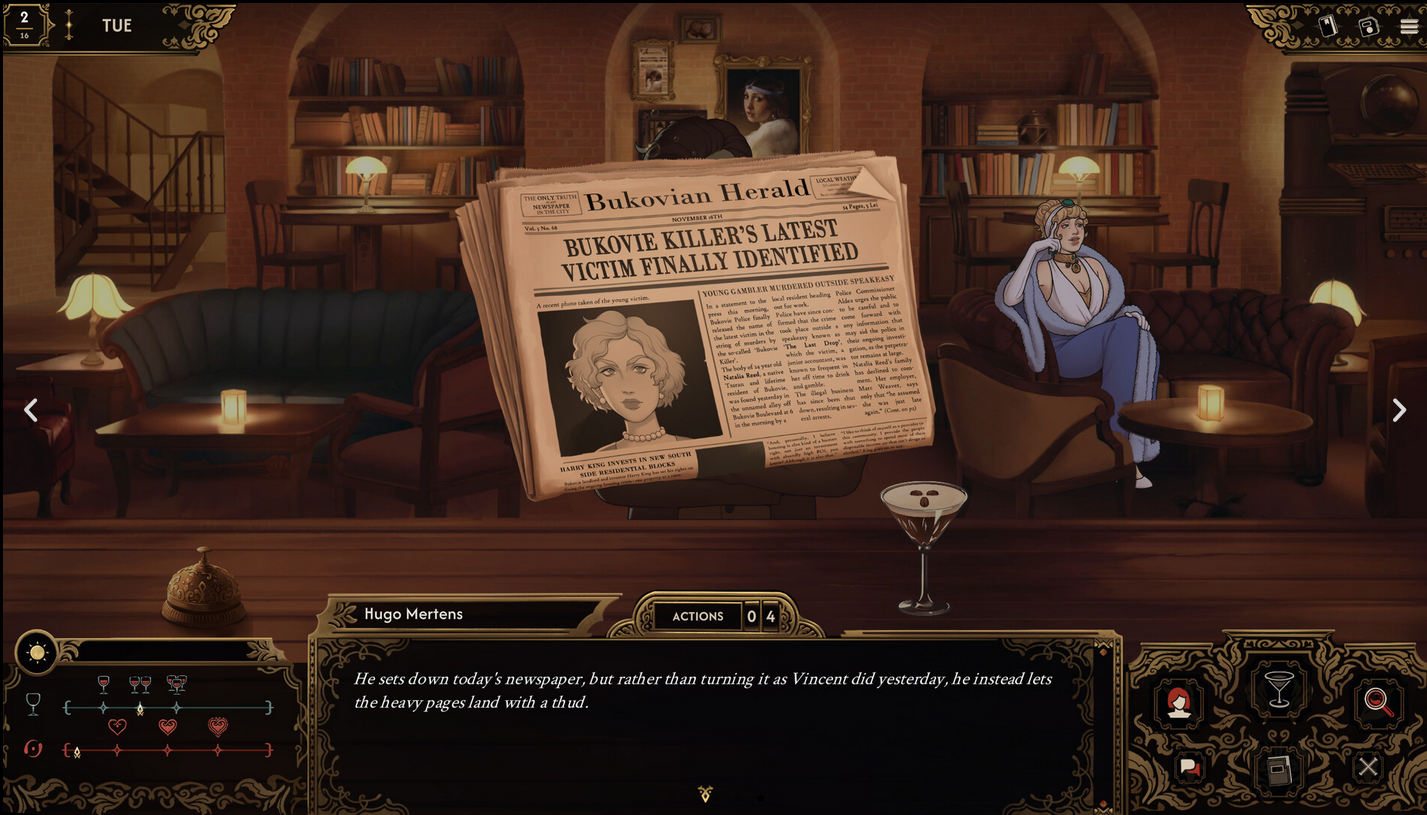
Most cases start with a newspaper handout, describing the situation to the player as well as who the potential suspects are.
Interlinked Systems
Keeping the systems of being a Bartender and Detective interlinked was an important challenge to overcome during the development of he game.
To enhance the experience, I opted for a Calendar system inspired by games like the Persona series. This added a sense of urgency to the narrative by introducing a clear deadline to solve the murder, and make each day feel like an actual workday to really make it feel like you were employed as a bartender.
At the end of each workday, the bartender goes home to their apartment where they can take the time to review and combine the clues they collected that day from speaking with their patrons.
Meanwhile, each character had their own preferences for drinks, how much alcohol they could tolerate as well as personalities that determined which topics they were willing to discuss.
The hardest challenge, by far, was striking a balance between maintaining a mystery and making the player feel smart, as well as keeping things accessible and intuitive.
Very often, writers were tempted to mark certain details as “obvious”, only to learn this doesn’t come as natural to someone who isn’t fully familiar with the case. My job, as a narrative designer, was to plan the clues with the writers and ensure they were spread out in a logical fashion. From there, we made sure each clue could be found within the chapter’s deadline of roughly 16 days.
Gameplay & Narrative
The development of Best Served Cold offered plenty of inspirational stories and mechanics that could be used to enhance gameplay or tells stories through intricate mechanics.
One idea I presented early during the development was the inclusion of a classic “ bar-distraction”. Something akin to a jukebox or telephone where a customer could toss in a coin and receive some basic entertainment.
This idea resulted in the "S.T.A.C.”, a basic computer terminal linked to an archive where you could toss in a quarter, ask a question, and the person on the other end would use books and texts stored near them to provide an answer. Essentially, we leveraged the idea of how a possible version of a search-engine could work with 1920s technology.
This S.T.A.C. would then play a major role in solving certain cases, with he person at the other end even becoming an important character that would be invited to visit the speakeasy.
Another strong mechanic for storytelling is “intoxication”. Drinks would cause patrons to potentially become drunk or tipsy, and only divulge information if they’re at or between certain thresholds.
Their resistance to alcohol was also unique, with some characters being able to handle strong drinks while others would get drunk very easily. This was visually represented by the User Interface and even served as a basis for storytelling.
For example, a character would be an alcoholic, and his favorite drink would be so strong he always leaves to go home and sleep it off. The player has to deny them their favorite drink, only using it sparingly for very specific mechanics.
Sandra Fischer enjoying her favorite drink, which can turn a Bad Mood into a Good Mood and gives maximum affection. Her Alcohol Tolerance is displayed in green in the bottom left of the screen.
In the background, the S.T.A.C. is visible on the right. between serving customers, the player can interact with it at any point and look up information.
Example of the Pixel Crushers Dialogue System in Unity, allowing each node to hold custom logic and functionality using simple Lua code for designers.
Technical Tools
The team opted to use the Unity Engine as we were most experienced with it.
A major boon to making Best Served Cold have tight links between dialogue and gameplay was the excellent “Pixel Crusher Dialogue System” plugin from the Unity Asset Store.
This system allowed us to import the story from an writing tool export, then add our custom gameplay features to them.
My job was using this tool to link the dialogue and gameplay together once the writers were finished. For example, I could make a dialogue option only appear if the character the player was talking to was considered “drunk”.
Externally, we had our writers use Arcweave, which was supported by the plugin and offered a very simple, easy-to-use web app to write dialogues.
During development, we encountered a variety of issues, such as lack of an automatic back-up system resulting in the loss of work as well as performance issues.
Writing Assistance
While not directly responsible for writing, ensuring the narrative made sense from a gameplay perspective was something I frequently assisted with. This mainly began with planning all the clues for each case at the planning stage.
As we were pressed for time during development, rather than have writer cover every dialogue from scratch based on our planning and apply the logic in Arcscript (the proprietary scripting language of Arcweave), I took it upon myself to create the entire core dialogue related to clues in the Arcweave writing system.
Each dialogue would contain the core information and whether or not it included a clue, as well as any external factors like whether or not the character had to be in a certain state in order for the player to see this dialogue. Once finished, the writer would go over these dialogues and fix them up with improved writing, keeping the core essence of each dialogue node while maximizing the quality of the writing.
Being is this position allowed me to pitch a few new ideas which were kept into the game. Additionally, the writer left certain dialogue largely unchanged as they liked what was being conveyed.
An example of Arcweave’s web-app. Writing was largely handled here as a collaborative effort between Writers, Artists (with writing experience) and Design.